What changes from mode to mode
Every question in Tidbit has four options and one right answer. That stays the same in every trivia mode. What changes is how a game ends: in one mode it never has to, and in the others it ends on a mistake, on a clock or on the tenth question.
That one rule changes how a game feels more than you’d expect. With nothing to lose you guess freely. With one life you read every option twice. This guide goes through each mode in turn, then helps you pick one for the time and the mood you have.
Freeplay: nothing to lose
Trivia Freeplay sits in the middle of Home. The game’s own line for it is “Play as long as you like. Nothing to lose.” There is no score to protect and no last question, so you can stop after any answer.
Freeplay is free and needs no sign-up. Its settings let you choose your subjects, and you can turn picture questions off there if you only want text.
Pick it when you want a break with no result attached, when you’re trying a subject for the first time, or when you have two minutes and don’t know how many questions that is.
Three Lives and Sudden Death: games that end on a mistake
- Three Lives: get three wrong and the game ends.
- Sudden Death: one wrong answer ends the game.
These two turn a string of questions into a run. You keep answering until the lives are gone, and the game remembers your best.
Three Lives leaves room for a bad guess or two, so it’s a good first scored game. Sudden Death is the strict one. It’s over quickly when it goes badly and gets tense when it goes well, because the fortieth question can end the run just as easily as the first.
Blitz, Sprint and Marathon: games against a clock
- Blitz: answer as many as you can in 30 seconds.
- Sprint: answer as many as you can in 1 minute.
- Marathon: answer as many as you can in 5 minutes.
In the timed modes the clock ends the game. That changes what a good habit looks like. Time spent staring at one hard question is time you don’t get back, so an honest guess and a move on is usually the better trade.
Blitz fits in the gap while a page loads. Marathon is closer to a real quiz round: long enough that your attention drifts and you have to pull it back.
Perfect Ten: ten questions and no mistakes
The game describes Perfect Ten as “Ten questions. One mistake and it is over.” It’s Sudden Death with a finish line. You know exactly how far away the end is, which makes question nine feel much heavier than question two.
It suits people who like a clean result. Either you got all ten or you didn’t, and you can start again straight away.
Category Run: ten questions on one subject
Category Run is “Ten questions on one subject you choose”, from any of the 30 subjects. A mistake doesn’t end it, so you always see all ten.
It’s the mode for testing yourself on one thing. Play it on a subject you think you know, such as history or geography, and how many of the ten you get is a fair first read on how right you are. Play it on a subject you avoid and you find out how bad it really is, which is often less bad than you feared.
Picture modes: Polaroid, Outlines, Flags and Historical Figures
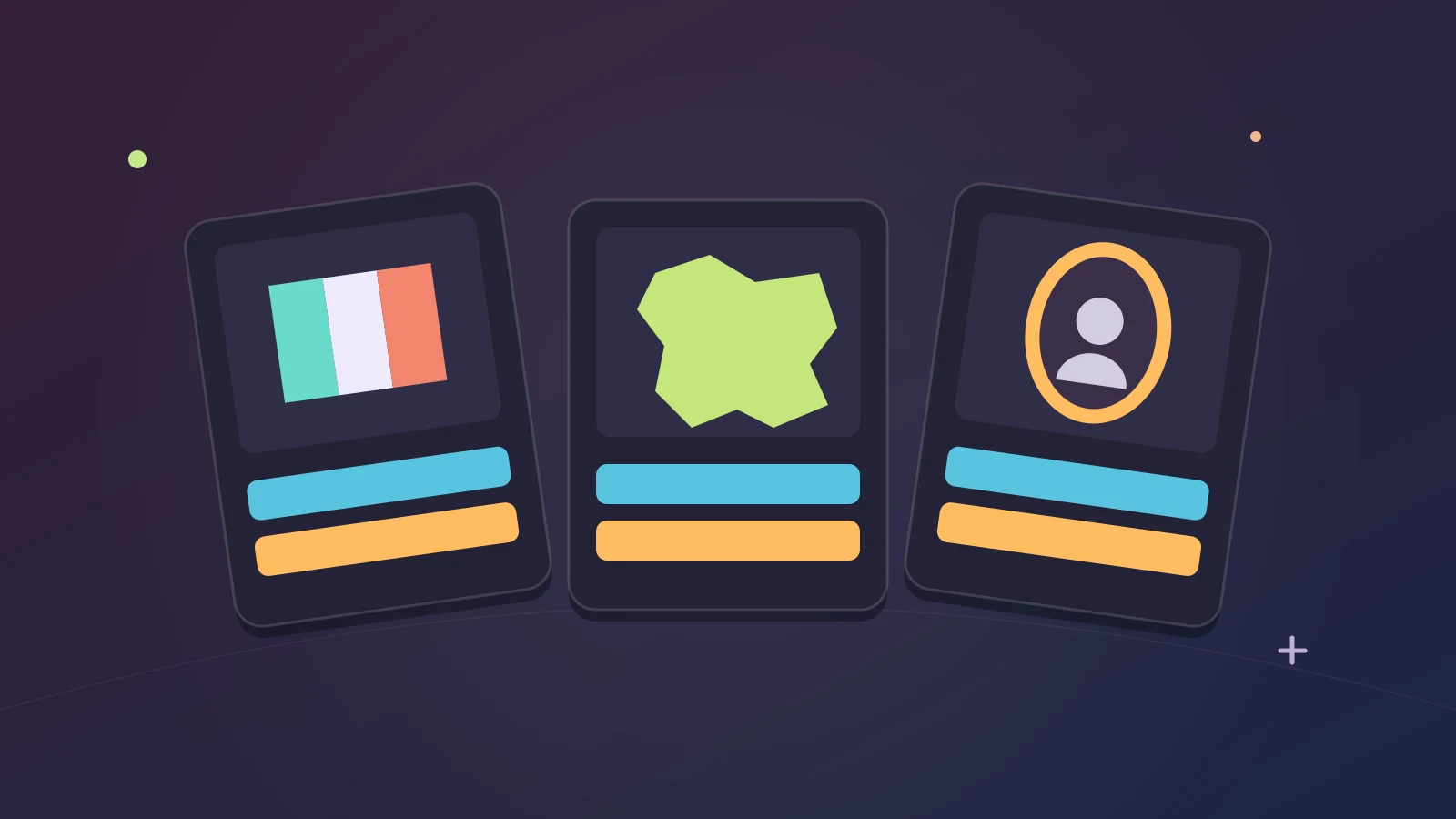
- Polaroid: every question is a picture, from every set.
- Outlines: name the country or state from its shape.
- Flags: name the country from its flag.
- Historical Figures: name the person from their portrait.
Each picture mode is ten questions. Polaroid mixes all the picture sets together, and the other three stay on one kind of picture so you can practice it on its own.
Pictures test a different kind of memory from text. You can know that a country exists, where it is and who its neighbors are, and still not recognize its outline. There’s more on that in the guide to picture trivia.
Reverse Trivia: the answer comes first
Reverse Trivia flips the card over. You see the answer, and you pick the question it belongs to out of four. A game is ten rounds.
It sounds like a small change and plays like a different game. A date or a name on its own could answer a dozen questions, so you end up working out what makes this answer special before you read the options.
Which modes are free
Freeplay is free. The other modes in this guide come with Premium, which unlocks every mode in Tidbit.
What Premium costs is in the plain list of what is free in Tidbit.
Pick a mode by the time you have
- Thirty seconds: Blitz.
- A minute: Sprint.
- A few minutes: Perfect Ten, Category Run or a picture mode. Each is ten questions.
- Five minutes: Marathon.
- No idea: Freeplay. Stop whenever you like.
The timed modes are the only ones that promise to end on schedule. Three Lives and Sudden Death end when you slip, which could be the second question or the sixtieth.
Pick a mode by what you want out of it
- To relax: Freeplay.
- To test one subject: Category Run.
- To practice speed: Blitz or Sprint.
- To practice staying careful: Sudden Death or Perfect Ten.
- To work on flags, shapes and faces: the picture modes.
- To think backwards for a change: Reverse Trivia.
A mix works well too. A Category Run to warm up, then a Three Lives game on everything, makes a decent ten minutes.
A first tour of the modes
- Start in Freeplay and answer until you’ve seen a few subjects.
- Play one Category Run on your favorite subject.
- Play one Three Lives game on everything.
- Try Blitz once, just to feel the clock.
- Finish with a picture mode.
Every step after the first needs Premium. The whole tour fits in a lunch break, and by the end you’ll know which kind of game you reach for.
Where to find the modes and your best scores
On a computer, Variations sits beside Trivia Freeplay on Home, and the Play menu in the top bar lists the games from any page. On a phone, Variations is in the bar at the bottom of the screen. The game’s own tour calls it the list of trivia modes and their rules. You can read the same list without opening the game on the game modes page.
Every scored mode keeps your best, and a best only ever goes up. A bad game never overwrites a good one, so one more try when you’re tired costs nothing.
Freeplay has no score, but what you answer there still earns XP and shows up in your statistics.
Where to go next
Higher or Lower has its own set of modes, with its own Three Lives, Blitz and Perfect Ten. They’re covered in the guide to Higher or Lower game modes.
Playing with other people? Parties have different modes again, from races to brackets: see the guide to party trivia modes.
Tidbit is for ages 13 and above.
By the team making Tidbit. Questions or a correction? Get in touch.