
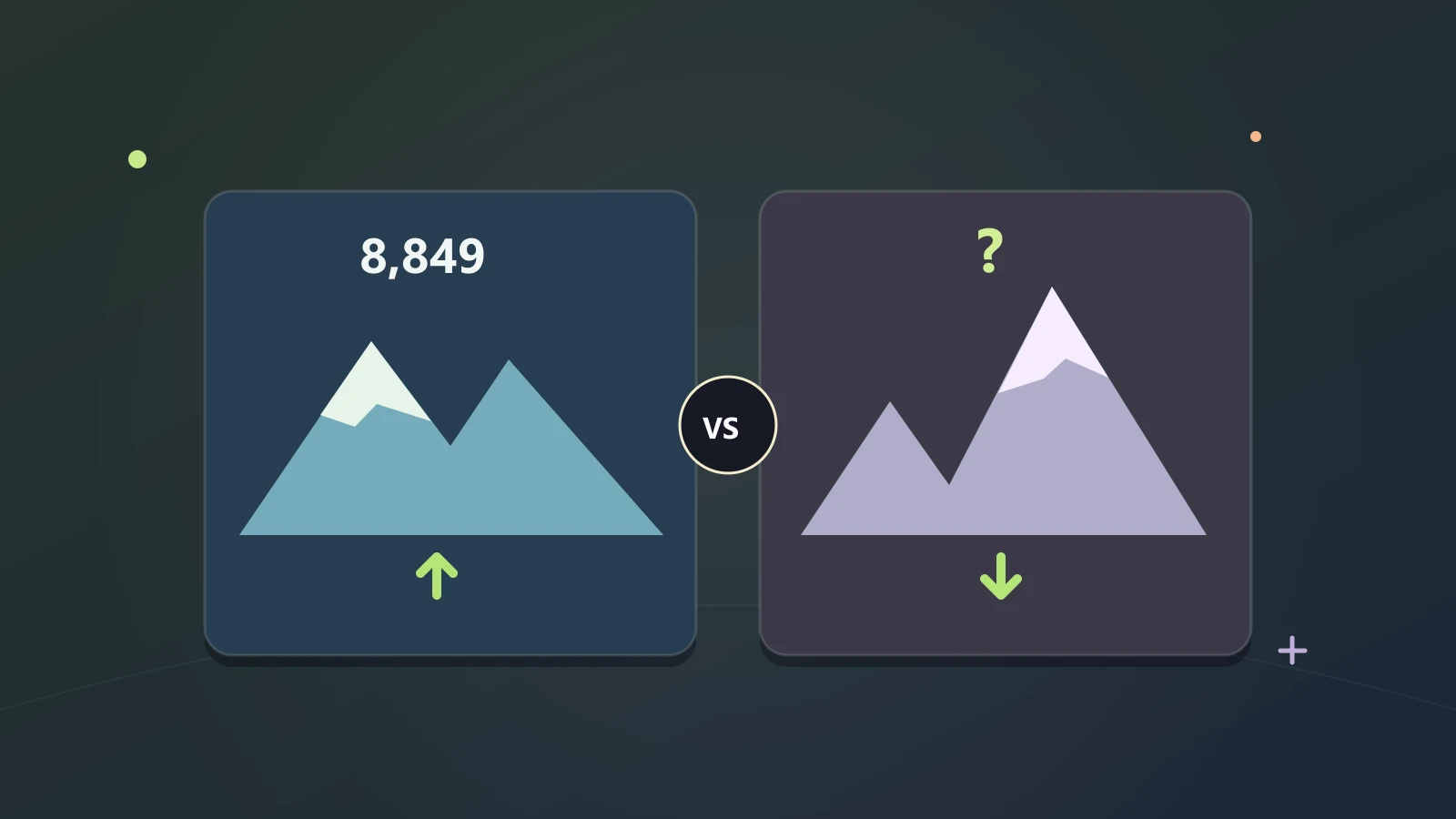
You only need to choose a direction
Traditional trivia asks you to identify an answer. Higher or Lower asks for a comparison: is this number above or below the other one? That makes room for estimates, instincts and the occasional answer that feels completely backwards.
Each Tidbit card names what its number measures. Read the category and unit before you compare. A height is not a distance traveled, and a price may refer to a particular item or date.
How to play Higher or Lower in Tidbit
- Open Tidbit and choose Higher or Lower from Home, or find it in Modes.
- Read the first card and its visible number. Then read the second card, including any unit or note.
- Choose Lower or Higher for the hidden number on the second card.
- Read the reveal, then move to the next comparison when you are ready.
The exact rules depend on the mode you choose. Freeplay is the place to start if you want to understand the comparisons without choosing a paid challenge first.
The detail underneath the number matters
A comparison is only useful when you know what is being measured. Check whether a card describes a total, a rate, a height or a value at a stated time. When a card includes a date or note, use it to interpret the number rather than silently assuming it means today.
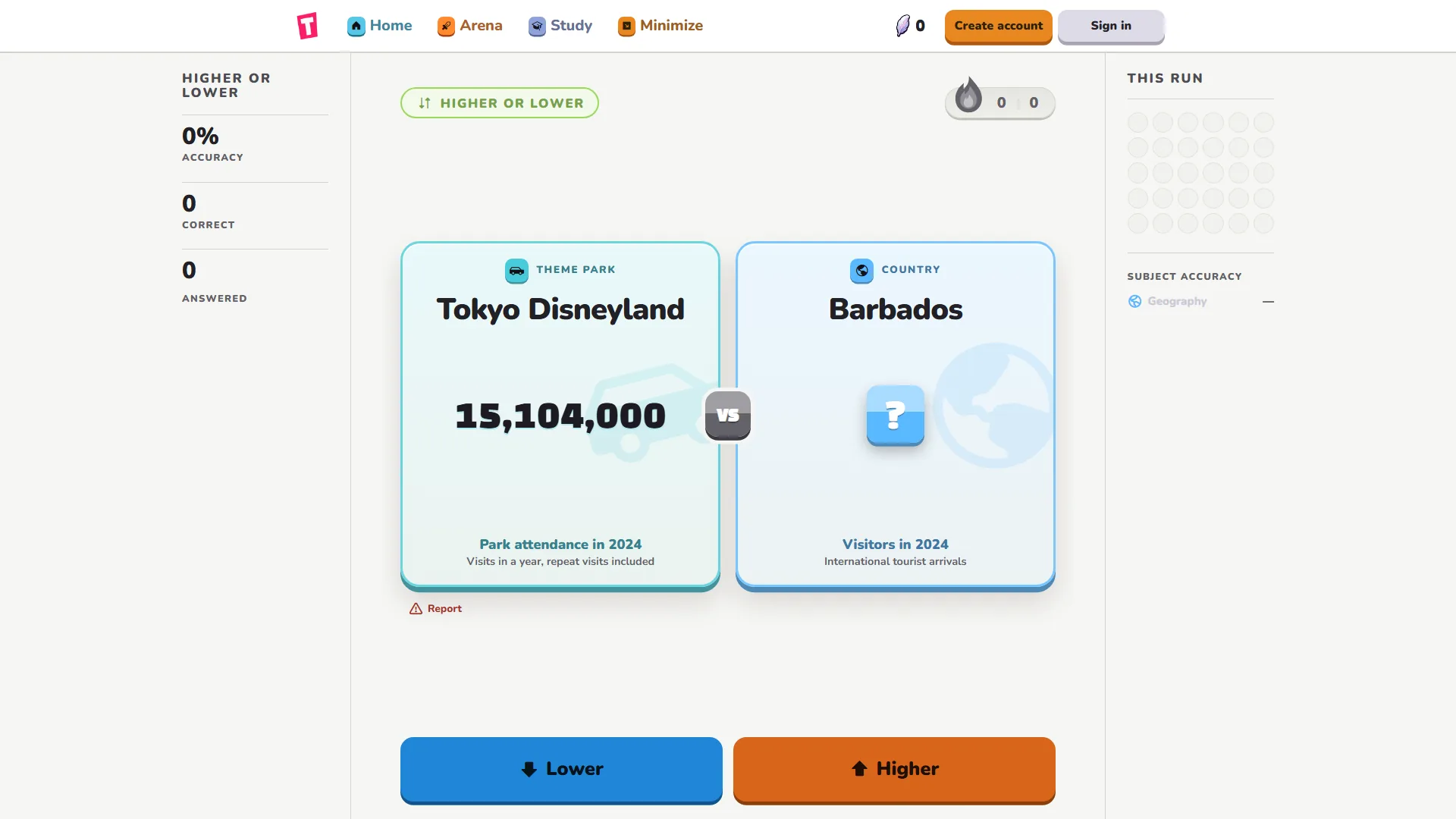
In the preview below, the left card is Tokyo Disneyland’s park attendance in 2024, which counts repeat visits. The right card is the number of international tourists who arrived in Barbados that year. Both count visits, but one counts trips through a park’s gates and the other counts arrivals in a country. Compare the quantities the cards actually name.
A quick check before choosing
- Read the unit: dollars, seconds, meters or another quantity. Compare the stated units rather than the size of the objects in the pictures.
- Read the scope: one item or a whole series, a total or a rate, an estimate or a measured amount.
- Read the date and note when present. A value tied to a year is not a claim about the current value.
You do not need to memorize every value to enjoy the game. Knowing which scale a number belongs on can be enough to make a good choice. The reveal is where you find out whether your sense of scale held up.
What the cards measure
- Money: a country’s yearly economy, a team’s value, a sale price. A yearly economy and one sale on one day are very different kinds of money.
- Time: life expectancy, time in office, how long something lasted. The lifespan of a species is not the age of one famous animal.
- Distance: a mountain’s highest point, a river’s length, a wingspan. Height and length are both distances, so check which one a card means.
- Counts: a population, visitors in a year, copies sold. Visitors count visits, so one person can count many times.
- Weight: a typical adult animal, a weight at birth, a planet’s mass.
- Speed: a top running speed, a top speed in service, a top wind speed.
- Area: a country’s total area, an island, a lake’s surface.
In each case the label tells you what kind of number you are comparing. Two numbers of the same kind can still measure different things, so read both cards before you choose.
Thinking in scale
- Ask which power of ten it is: thousands, millions or billions.
- Use anchors you already know: the population of your own country, the height of a tall building, the price of a coffee.
- Ask whether one number could really be ten times the other. If not, the call is closer than it looks.
- Remember that a famous thing is not always a big one.
You rarely need the exact figure. Most calls are settled by knowing roughly how big something is. When two numbers feel close, they often are, and that is when the unit and the date on each card matter most.
When a call goes wrong
Read the reveal. A surprising answer is the best part of the game: it shows you where your sense of scale was off, and the next card with that kind of number will feel easier. Freeplay keeps a streak, so there is always a number to beat.
Some of the best calls are the ones that feel backwards, like a small country with a big population.
Higher or Lower and trivia
The two games use different skills. Trivia asks what you know; Higher or Lower asks how big you think things are. Switching between them is a good way to keep a long session fresh.
More ways to play
Beyond Freeplay, Higher or Lower has modes that keep to one kind of number, scored runs with lives or a clock, and modes that hide the numbers, keep to huge ones or deal only close calls. There is a full guide to Higher or Lower game modes.
To play now, open Higher or Lower.
By the team making Tidbit. Questions or a correction? Get in touch.